What changes about you between 25 and 45
Imagine showing your twenty-five-year-old self a list of your thirty-five-year-old habits. Half would be no surprise — the same impatience with disorganised meetings, the same quiet preference for books over parties, the same particular way of falling asleep. But half would be unfamiliar. The fact that you save now before you spend. The patience you have developed with people whose company you would once have avoided. The way you handle bad news without spending three days underwater.
How much of this is personality change, and how much is just experience? The answer turns out to be one of the more interesting things research has uncovered in the last few decades — and it directly affects how you should read any personality assessment you take at this stage of your life.
The old assumption
For most of the twentieth century, psychology operated on the view that personality was largely set by about age twenty-five. Whatever shape you had taken by then was, give or take, who you would be. Some of this came from clinical experience, some from the limits of the longitudinal data available at the time.
This view, it turns out, was about half right.
What thirty years of research actually shows
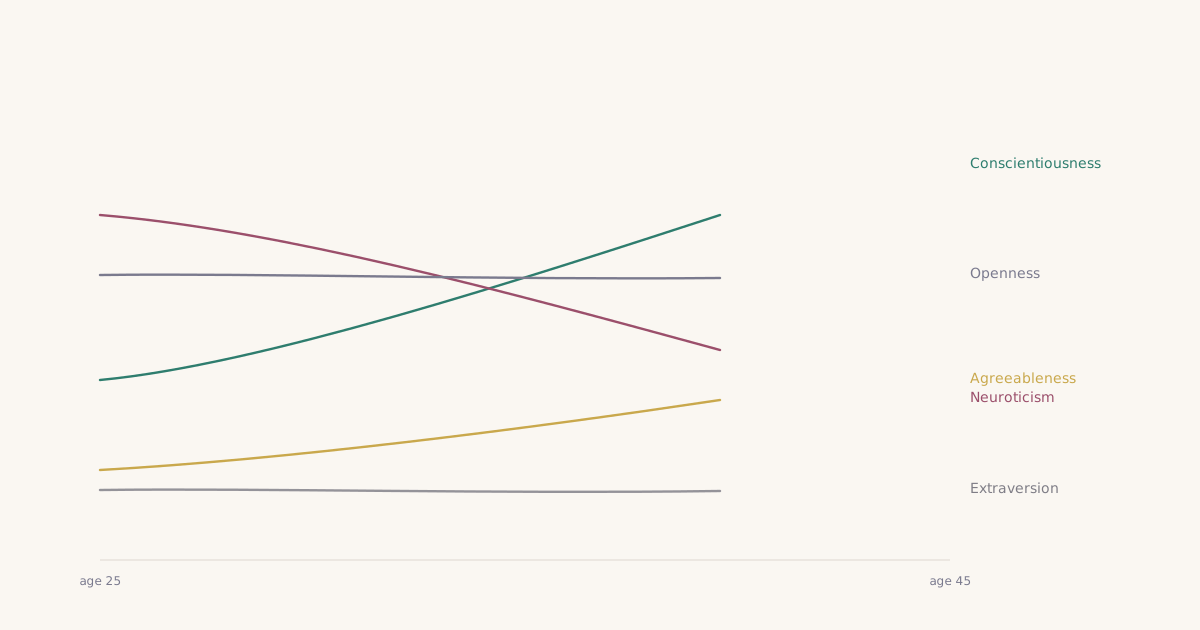
Researchers who have followed the same people for two and three decades, measuring them at five-year intervals, have found something more subtle than either "personality is fixed" or "anyone can become anything." Several of the Big Five dimensions shift in predictable directions through young and middle adulthood, in patterns so consistent that they appear across countries, including India.
Conscientiousness rises. People become more organised, more reliable, more goal-directed through their late twenties, thirties, and early forties. The twenty-two-year-old who could not be trusted to remember a friend's birthday is often the thirty-eight-year-old who runs a household and a team and forgets nothing.
Agreeableness rises gently. The sharper edges soften. People become slower to take offence, more willing to assume good faith, less interested in being right at the cost of being kind. This shift is real but smaller than the conscientiousness one.
Neuroticism declines. Emotional reactivity to small frustrations and uncertainties tends to ease through the thirties and forties. The minor inconvenience that would have unsettled you at twenty-six often does not register at thirty-eight. People describe it as "settling," but it shows up in the data as a real shift in temperament.
Openness stays roughly flat. Most people remain about as curious, about as drawn to new ideas, about as comfortable with abstract thought as they were in their twenties. Some research suggests a very slight decline after fifty, but through the 25–45 window, the dimension holds.
Extraversion stays roughly flat too, although the way it expresses itself often changes. The same person who needed parties at twenty-three may need long dinners with three close friends at thirty-eight. The underlying need for connection is the same; the form has matured.
What does not change
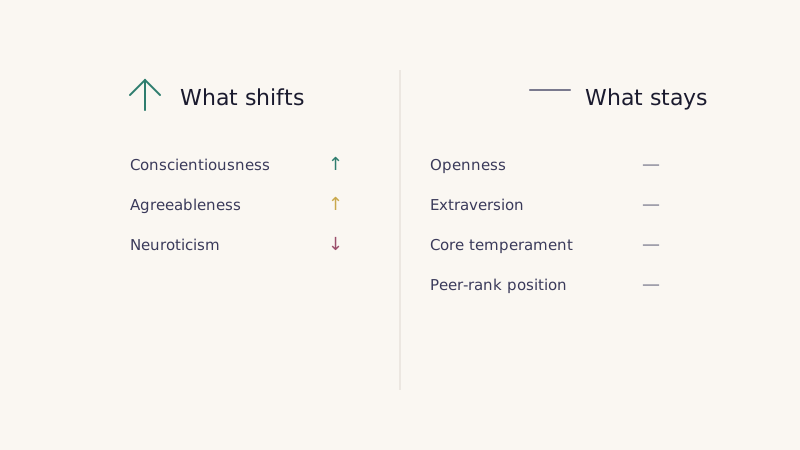
What stays remarkably stable, across all five dimensions, is your rank among peers. If you were among the more conscientious people in your peer group at twenty-five, you will probably still be among the more conscientious at forty-five — even though your absolute conscientiousness has likely increased. Personality changes are mostly parallel shifts, not reshuffles.
Your core preferences and the way you process experience — what you find energising, what you find draining, what you instinctively reach for in a difficult situation — also tend to hold. These are the deepest layers of personality. They are not immune to change, but they move slowly.
What accelerates the changes
Major life events appear to compress the timeline. Becoming a parent, in particular, has been linked to measurable rises in conscientiousness — there is suddenly an organisation no one else will do. Long-term partnership tends to be associated with shifts in agreeableness and small declines in neuroticism, especially when the partnership is supportive. Career transitions, especially the move from individual contributor to leader, tend to accelerate the same conscientiousness rise.
In Indian contexts, geographic relocations — to a new city for work, or abroad — appear to amplify openness for those who engage with the new environment. Returning home after time away often reshapes agreeableness in ways the person themselves is the last to notice.
What this means for how you read an assessment now
If you are twenty-five and taking a personality assessment today, you are taking a snapshot of someone who is still forming. The report is accurate for who you are now, and it is most useful as a baseline to revisit in five and ten years. Some of what it reveals will look different by then.
If you are thirty-five, you are closer to your settled self. The report is closer to who you will continue to be, with some softening expected on the harder edges. Most of what shows up in the assessment will still be there at forty-five.
If you are forty-five or older, your patterns are well-formed. The report becomes less about anticipating change and more about understanding how to navigate the patterns you have. Few people fundamentally rewire themselves after this point — the more interesting work is learning to work with the personality you have, not against it.
A reflective close
There is something quietly reassuring in this research. The parts of yourself that have caused you the most friction in your twenties — the anxiety, the disorganisation, the impatience — are also the parts most likely to soften through your thirties and forties, without you having to consciously fight them. You are not stuck with who you were at twenty-five.
There is also something to be sober about. The parts of yourself that you have always known to be true — the way you fundamentally engage with the world — are mostly going to stay. They will refine and mature, but they will not disappear. Knowing them well, early, is one of the most useful pieces of self-knowledge you can carry forward.
Whatever age you take an assessment at, the report is most useful when you treat it as one moment in a longer arc. You can take the My Personality assessment in about fifteen minutes from home.
Within Lies Clarity.
Frequently asked questions
Is it worth taking the test in my twenties if my scores will keep changing?
Yes, and arguably more useful than waiting. The shape of your profile in your twenties is the baseline that everything else moves from. Most of what shifts is gentle and predictable, and knowing where you start gives you a clearer view of what is changing and what is settling. Many people find it valuable to take the assessment once in their twenties and again about a decade later.
Which life events tend to accelerate personality change?
Becoming a parent is the most-studied accelerator, particularly for conscientiousness. Long-term partnership, the move from individual contributor to leader at work, and significant geographic relocation also appear in the research. These events do not rewrite personality, but they compress trajectories that would otherwise unfold more slowly.
Can I deliberately change a dimension I do not like in myself?
Within limits, yes. Targeted work — therapy, sustained practice of a particular kind of behaviour, structured habit change — can move a dimension by a meaningful amount over a year or two. The change is rarely dramatic, but it is real. The dimensions most responsive to deliberate work are conscientiousness and neuroticism; agreeableness and openness move too, more slowly.
Does the research hold up in Indian populations?
The broad pattern — conscientiousness and agreeableness rising, neuroticism declining, openness and extraversion roughly stable through young and middle adulthood — has been replicated in Indian samples as well as samples from over fifty other countries. There are small cultural differences in the speed and timing of some shifts, but the directions are consistent.