What personality tests can and can't tell you about yourself
By the time someone arrives at theinnerly.com to consider a personality assessment, they have usually already taken three or four others. A BuzzFeed quiz that placed them in a Hogwarts house. A free MBTI test on a colleague's recommendation that called them an INFJ. A team-building exercise at work that produced a colour. Perhaps something a relative did at home, in a tradition that has been around far longer than psychology has existed as a science.
So when Innerly asks people to spend fifteen minutes on yet another test, the fair first question is: why this one, and what will it actually give me?
The honest version of the answer is more interesting than the marketing version.
What a personality assessment is actually measuring
A scientific personality assessment is not trying to put you in a category. It is trying to describe where you sit on a small number of dimensions that, decades of research has shown, capture most of the meaningful variation in how human beings think, feel, and behave.
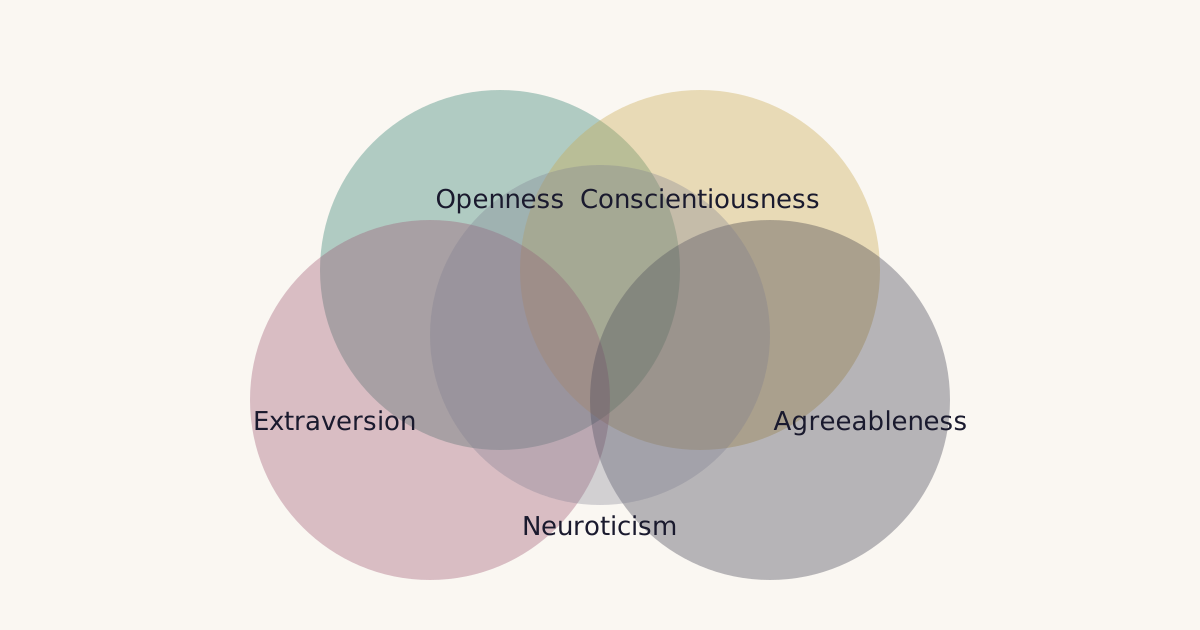
The Big Five framework, which the My Personality assessment is built on, measures five such dimensions:
- Openness — how drawn you are to new experiences, ideas, and abstract thought
- Conscientiousness — how organised, disciplined, and goal-directed you tend to be
- Extraversion — where you draw energy from, and how outwardly expressive you are
- Agreeableness — how cooperative and trusting you are in your dealings with others
- Neuroticism — how reactive your emotional system is to stress and uncertainty
You are not high or low on any single one of these. You sit somewhere on a continuum. Most people are mixed across the five, with one or two stronger leanings.
These dimensions came out of decades of research across cultures, including India. They were not invented by a marketing team. They are what consistently appears when researchers analyse the words people use to describe themselves and others, the patterns clinicians observe, and the behaviours that show up reliably across situations.
What a good personality report can do for you
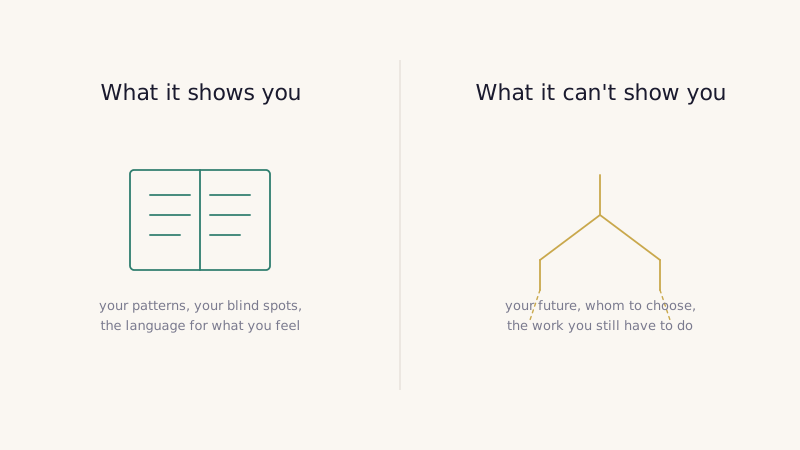
When you understand where you sit on these five dimensions, three things become more visible than they were before.
The first is your patterns. You begin to notice that the things that drain you at work are not the things that drain a colleague who looks superficially similar. That what feels like a moral position for you may be a personality preference. That what looks like procrastination from outside might be a deliberate way of working that suits how you actually function.
The second is your blind spots. Self-reports of personality have known weaknesses — we tend to underestimate our weaker traits and overestimate our stronger ones. A well-constructed assessment quietly works around this by asking the same underlying question in several ways. The result is often closer to how the people around you experience you than to how you experience yourself in the moment.
The third is the language to talk about yourself. People with high self-awareness do not have more self-knowledge than others by accident. They have language for what they are experiencing. The Big Five gives you that language.
What it cannot do, and why honesty here matters
A personality report cannot predict your future career. It can illuminate why some types of work tire you and others energise you, but the choice to pursue them remains yours.
It cannot tell you whom to marry. It can give you and a partner a clearer sense of where your patterns overlap and where they diverge — which is the work that the Couples Compatibility assessment does — but it does not turn a relationship into a calculation.
It cannot fix any pattern you do not want to engage with. Knowing that you score high on neuroticism does not, by itself, make you less anxious. It points to where work, if you are willing to do it, would be most useful.
It cannot replace conversations with a friend, a therapist, or a partner. Self-knowledge is one input. It is not the whole of becoming the person you want to be.
How to read your results without misreading them
The most common mistake people make with a personality report is to treat it as identity rather than information. You are not your scores. You are a person who, today, with the responses you gave today, leaned in certain directions on certain dimensions. Five years from now, with deliberate work, some of those scores could meaningfully change. Others probably will not. Both are fine.
The second most common mistake is to use the report to explain away rather than to investigate. "I'm just an introvert" can be true and also not the whole story. The report is a starting point for a question, not a closing answer.
The third is to share it with people who will not read it carefully. Personality results, like medical results, deserve thought. Treat them that way.
A quiet invitation
If, after reading this, the prospect of fifteen minutes of careful self-reflection sounds useful rather than performative, the My Personality assessment is here. It is built on the Big Five framework, adapted for the Indian context, and produces a detailed report you can read alone or share. ₹299. From home.
If it sounds like one more thing you do not need today, that is also a useful piece of self-knowledge.
Within Lies Clarity. It comes from honest looking, not from any test.
Frequently asked questions
Are scientific personality tests really different from the quizzes I see online?
Yes, in important ways. A scientifically grounded assessment is built on decades of statistical work — it asks dozens of questions across overlapping themes to triangulate where you actually sit, rather than placing you in a fixed category from a handful of answers. Online quizzes are usually entertaining but not validated. The Big Five framework, in particular, has been replicated across more than fifty countries and remains the standard in academic research.
Will my results change if I retake the test in a few months?
The big shape of your profile is unlikely to shift much over a few months. Scores can move a little depending on mood, stress, and how you happen to be reading the questions on a given day, which is why well-designed assessments use multiple items per dimension to smooth that noise out. Across years, especially through your late twenties and thirties, some dimensions do genuinely shift, and that is worth knowing.
Can I share my report with a partner or a therapist?
You can, and many people find it useful to do exactly that. A Big Five report can give a therapist a quick read of where to start, and it can give a partner language for things you have both probably noticed without being able to name. Treat it as a starting point for conversation rather than a verdict to deliver.
Is my data kept private?
Yes. Your responses and report are stored privately under your account. They are not shared with anyone, sold to third parties, or used for advertising. You can read more in our privacy policy.